What is Artificial Intelligence AI? It is one of the most talked-about technologies in the world today. From smartphones and voice assistants to online shopping and social media recommendations, AI is becoming a part of everyday life.
But what is Artificial Intelligence AI?, and why is everyone talking about it?
If you are a beginner who feels confused by technical terms, don’t worry. This beginner-friendly guide explains Artificial Intelligence in simple words, how it works, its types, benefits, challenges, and real-life examples.
By the end of this article, you will clearly understand how AI works and why it is shaping the future.
What is Artificial Intelligence AI?
So, what exactly is AI? Artificial Intelligence (AI) is technology that enables machines or computer systems to think, learn, solve problems, and make decisions like humans.
In simple words, AI allows computers to perform tasks that normally require human intelligence.
These tasks include:
- Understanding language
- Recognizing images
- Solving problems
- Learning from data
- Giving recommendations
- Making decisions
For example:
- When you ask a chatbot a question and receive an answer instantly, AI is working behind the scenes.
- When Netflix recommends movies you may enjoy, AI analyzes your preferences.
- When Google Maps shows the fastest route, AI helps predict traffic conditions.
AI Explained in Beginner-Friendly Language
Think of Artificial Intelligence as a smart assistant.
Just like humans learn through experience, AI systems learn from data and patterns.
For example: If a child sees hundreds of cat pictures, they eventually recognize a cat instantly.
AI learns in a similar way. A computer system studies thousands of examples and becomes smarter at identifying patterns.
This is why AI can recognize faces, recommend products, or even answer questions.
Why is Artificial Intelligence Important?
Artificial Intelligence matters because it helps people and businesses save time, improve accuracy, and automate repetitive work.
Today, AI is used in:
- Healthcare
- Education
- Banking
- Marketing
- E-commerce
- Transportation and Navigation
- Fraud prevention
- Predictions
- Gaming
- Analytics
- Customer support
- Social media
- Online shopping
- Digital assistants
- Search engines
Businesses love AI because it helps improve efficiency and productivity.
For example: An online store can use AI to recommend products based on what customers previously searched for.
Instead of guessing, businesses can make smarter decisions using AI insights.
Why AI is Growing Fast
The growth of AI is happening because:
- More data is available
- Computers are faster
- Businesses want automation
- Customer expectations are increasing
In short, AI helps companies work smarter instead of harder.
How Does Artificial Intelligence Work?
Many beginners ask:
How does Artificial Intelligence work?
The good news is that the answer is simpler than it sounds. works by using computer systems that learn from data and past experiences to achieve various outcomes, such as recognizing patterns, making predictions, generating new content and performing other specific tasks.
AI works by:
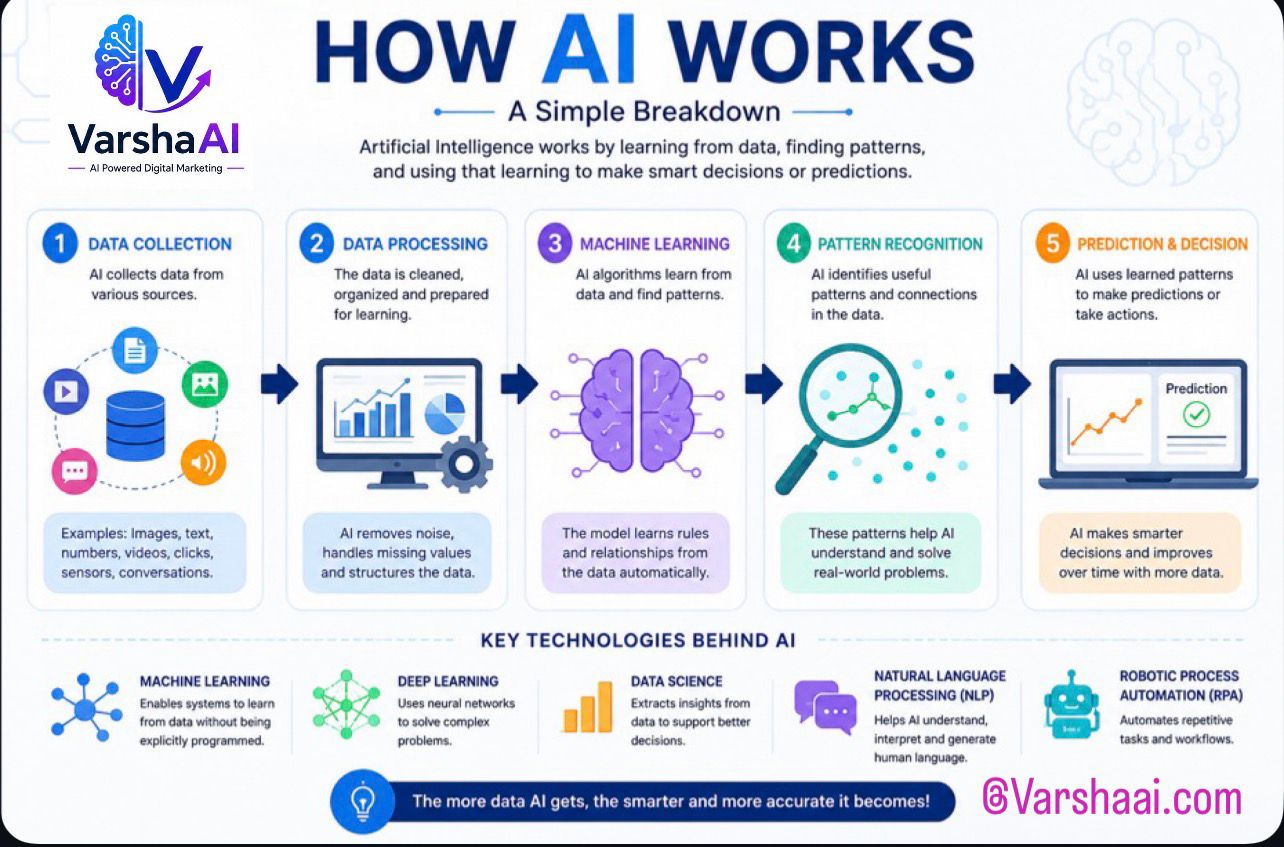
1. Data Collection
AI systems first gather information.
For example: Netflix studies:
- Movies watched
- Viewing history
- Watch time
- Likes and preferences
This data helps AI understand what users enjoy.
2. Data Processing
Raw data is often noisy, incomplete, or disorganized. AI processes data by ingesting massive amounts of raw information, cleaning it, and passing it through complex algorithms to extract patterns.
For example: converting pixel colors into numerical matrices.
3. Pattern Recognition
AI analyzes the information and looks for trends.
For example: If you watch action movies regularly, Netflix AI notices the pattern.
4. Learning from Experience
AI improves over time. The more data it gets, the smarter it becomes. This process is called Machine Learning.
Machine learning is a branch of AI where systems learn automatically without being manually programmed every time.
5. Making Predictions or Decisions
Finally, AI provides recommendations or solutions.
For example:
- Spotify recommends songs
- YouTube suggests videos
- Google predicts search results
AI learns and improves continuously.
Types of Artificial Intelligence
There are different types of AI.
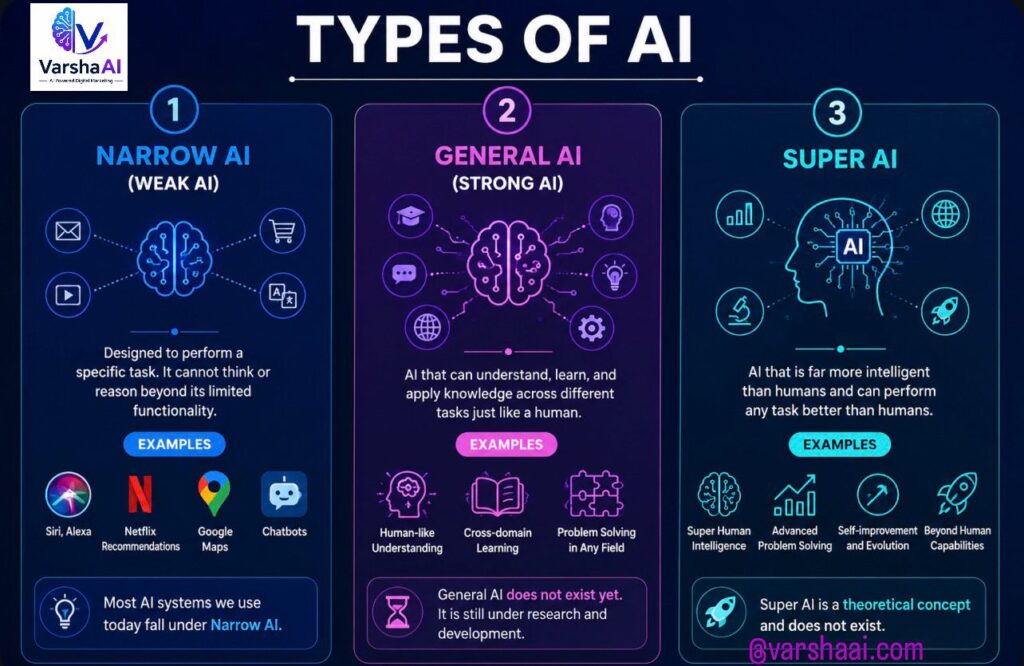
1. Artificial Narrow Intelligence (ANI)
Also known as “Weak AI.” These systems are highly specialized to perform a single, specific task, like facial recognition, image classification, and autonomous warehouse navigation. Almost all AI in use today falls under this category.
Examples include:
- Siri
- Alexa
- Google Assistant
- Recommendation systems
Narrow AI is smart in one area but cannot think like humans.
For example: A chatbot may answer questions but cannot cook food or drive a car.
2. Artificial General Intelligence (AGI):
Often referred to as “Strong AI.”.
General AI refers to machines that can think like humans and solve many different problems.
This level of AI does not fully exist yet. Scientists are still researching it.
3. Artificial Superintelligence (ASI):
Super AI is a theoretical idea where machines become smarter than humans.
Many movies show this concept, but it does not currently exist.
Examples include science fiction robots.
Explore more helpful guides on AI, SEO, and Digital Marketing in our latest blog collection.
Read more here: Click Here
Real-Life Examples of Artificial Intelligence
If you still wonder what is Artificial Intelligence AI?, the easiest way to understand it is through real-life examples.
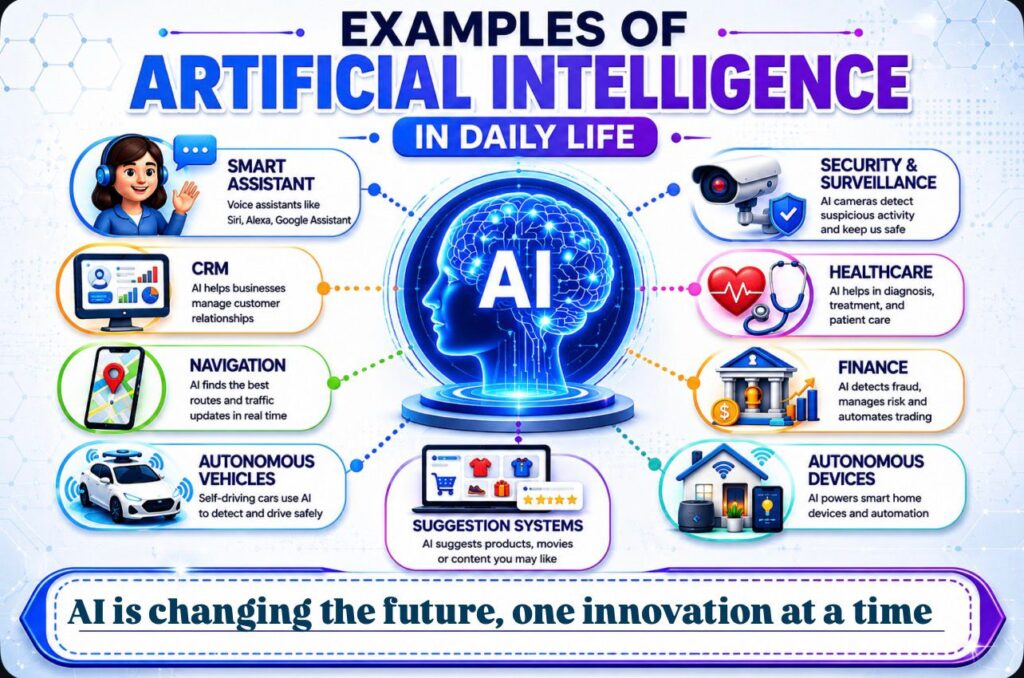
You are probably already using AI every day without realizing it.
1. Chatbots and Virtual Assistants
Have you ever spoken to Siri, Alexa, or Google Assistant?
These tools use AI to understand commands and answer questions.
Examples:
- Asking Siri to set an alarm
- Using Alexa to play music
- Chatbots answering customer support questions
AI helps these systems understand language and respond intelligently.
2. Netflix and YouTube Recommendations
Ever noticed how Netflix recommends movies you actually like?
Or how YouTube keeps showing videos you enjoy?
That is AI.
AI studies:
- What you watch
- How long you watch
- What you skip
- What you search for
Then it predicts what content you may enjoy next.
3. Google Maps
Google Maps uses AI to suggest:
- Fastest routes
- Traffic updates
- Travel time predictions
AI studies real-time traffic and helps users save time.
4. Online Shopping Recommendations
When online stores say:
“You may also like this product”
That is AI in action.
Platforms analyze:
- Browsing behavior
- Shopping history
- Interests
Then recommend products based on user behavior.
5. Social Media Platforms
Instagram, Facebook, and TikTok also use AI.
AI helps:
- Show relevant content
- Recommend reels or videos
- Personalize advertisements
This makes social media more engaging.
6. Smart Email Spam Filters
Have you noticed spam emails automatically move into a spam folder?
AI recognizes suspicious patterns and filters unwanted messages.
Benefits of Artificial Intelligence
There are many reasons businesses and individuals love AI.
1. Saves Time
AI automates repetitive work.
For example:
Instead of manually replying to customer questions, businesses use AI chatbots.
This saves hours of work.
2. Better Decision Making
AI analyzes huge amounts of data quickly.
Businesses use AI to make smarter decisions based on trends and insights.
For example:
Marketing companies use AI to predict customer behavior.
3. Personalization
AI creates personalized experiences.
Examples include:
- Product recommendations
- Personalized ads
- Movie suggestions
- Customized content feeds
This improves customer satisfaction.
4. Increased Productivity
AI tools help people work faster.
For example:
Writers use AI tools for brainstorming ideas.
Businesses automate emails and customer support.
Employees can focus on more important tasks.
5. Better Customer Support
AI chatbots can answer customer questions instantly.
Benefits include:
- Faster replies
- 24/7 support
- Better customer experience
Challenges and Limitations of Artificial Intelligence
Although AI has many advantages, it also has challenges.
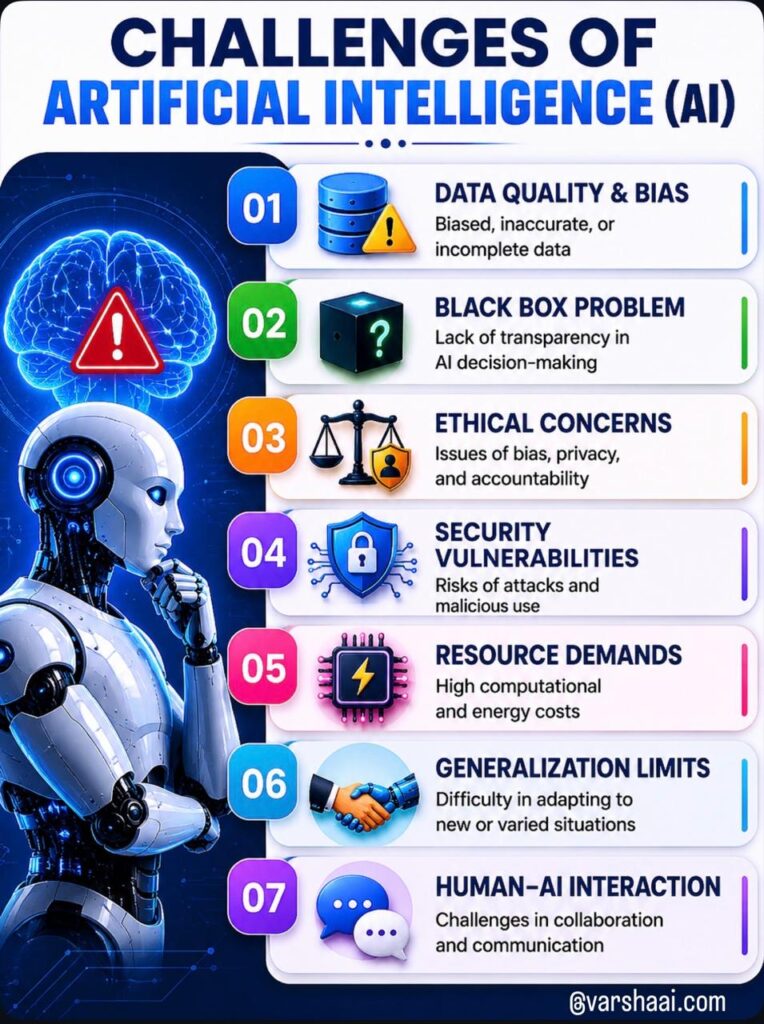
1. Privacy Concerns
AI often relies on user data.
Many people worry about:
- Data privacy
- Information security
- Personal tracking
This raises ethical concerns.
2. Job Automation Concerns
Some people fear AI may replace jobs.
For example:
Automation can reduce repetitive manual work.
However, AI also creates new career opportunities.
3. High Dependency on Data
AI systems need quality data.
Bad or incomplete data can lead to poor decisions.
Simply put:
Bad data = bad AI results
4. Ethical Issues
AI systems may sometimes make biased decisions.
For example:
If an AI model learns from biased information, results may also become biased.
This is why responsible AI development matters.
5. Lack of Human Emotions
AI can process information quickly, but it cannot truly understand emotions like humans.
A chatbot may answer questions, but it cannot fully replace human understanding.
What is Artificial Intelligence AI in Digital Marketing?
Since this blog is on Varsha AI, let’s connect AI with digital marketing.
AI is transforming digital marketing in powerful ways.
Businesses now use AI to:
1. Create Content Faster
AI writing tools help marketers:
- Generate ideas
- Write blog drafts
- Improve SEO content
- Create social media captions
This saves time and increases productivity.
2. Improve SEO
AI tools help marketers:
- Find keywords
- Optimize content
- Analyze competitors
- Improve rankings
For example:
AI SEO tools suggest better titles, keywords, and content improvements.
3. Marketing Automation
AI helps automate repetitive tasks like:
- Email marketing
- Lead generation
- Customer segmentation
- Social media scheduling
This allows businesses to scale faster.
4. Personalized Advertising
AI helps companies show personalized ads.
For example:
If you searched for shoes online, AI may later show shoe ads on social media.
This improves marketing results.
5. Customer Support Chatbots
Many websites now use AI chatbots to:
- Answer questions instantly
- Solve customer issues
- Guide users
This improves customer experience and saves time.
In simple words:
AI helps marketers work smarter, save time, and achieve better results.
Future of Artificial Intelligence
The future of AI looks exciting.
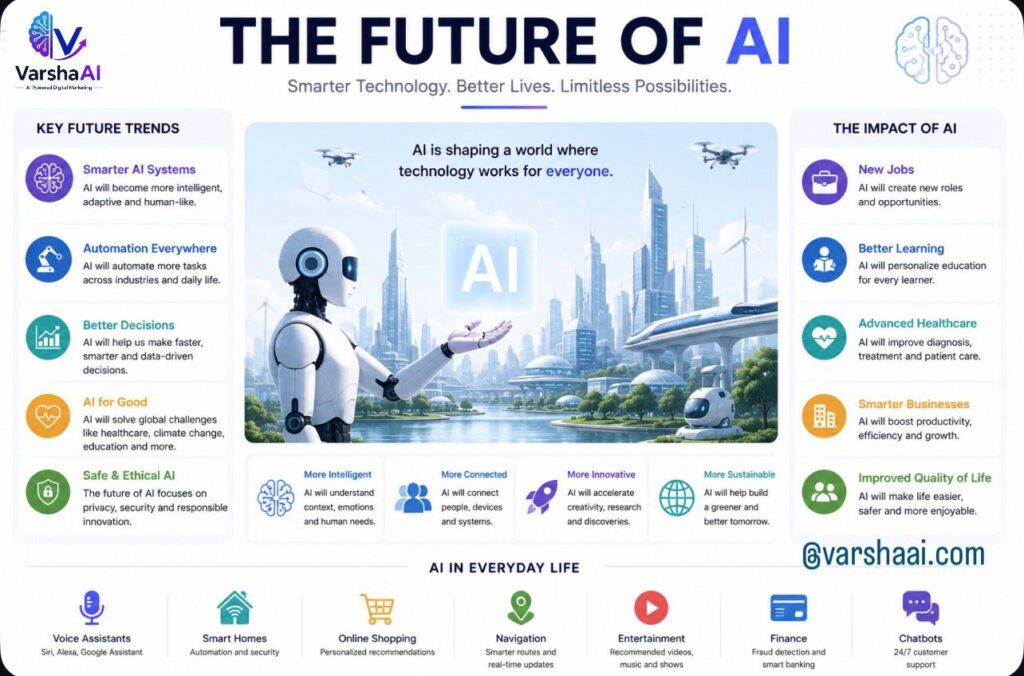
Experts believe AI will continue transforming industries.
In the coming years, AI may improve:
- Healthcare systems
- Education platforms
- Transportation
- Business automation
- Digital marketing
- Customer experiences
We may also see smarter assistants and better automation tools.
For beginners, learning AI today can open many opportunities.
Whether you are:
- A student
- Business owner
- Freelancer
- Marketer
- Content creator
Understanding AI can give you a strong advantage.
Frequently Asked Questions (FAQ)
Q-1. What is Artificial Intelligence AI? (in simple words)
Artificial Intelligence (AI) is technology that helps computers think, learn, and solve problems like humans.
In simple terms, AI allows machines to perform smart tasks such as understanding language, giving recommendations, recognizing images, and answering questions.
For example:
- Siri answering questions
- Netflix recommending movies
- Google Maps showing routes
All of these use AI.
Q-2. How does Artificial Intelligence work?
Artificial Intelligence works by collecting data, finding patterns, learning from experience, and making decisions.
In simple steps:
- AI collects information
- It studies patterns in data
- It learns from past results
- It gives predictions or recommendations
For example: YouTube learns what videos you like and recommends similar content.
Q-3. What are examples of Artificial Intelligence?
There are many real-life examples of AI.
Popular examples include:
- ChatGPT
- Siri and Alexa
- Netflix recommendations
- Google Maps navigation
- YouTube video suggestions
- Online shopping recommendations
- AI chatbots
Most people already use AI daily without realizing it.
Q-4. What are the benefits of Artificial Intelligence?
Artificial Intelligence provides many benefits, including:
- Saving time
- Better decision-making
- Automation of repetitive tasks
- Personalized experiences
- Increased productivity
- Faster customer support
Businesses use AI to improve efficiency and reduce manual work.
Q.5 Is Artificial Intelligence difficult to learn?
No, Artificial Intelligence is not difficult to understand at a beginner level.
You do not need coding knowledge to understand basic AI concepts.
Start by learning:
- What is Artificial Intelligence AI?
- How AI works
- Real-life AI examples
- AI tools used in business and marketing
Over time, you can learn advanced concepts if interested.
Q-6. Can beginners use AI?
Yes.
Today, many AI tools are beginner-friendly.
For example:
- AI writing assistants
- AI image generators
- Chatbots
- AI productivity tools
Even business owners and marketers with no technical background can use AI.
Conclusion
Now that you understand what is Artificial Intelligence AI?, you can see why AI is becoming one of the most important technologies in the modern world.
Artificial Intelligence helps machines think, learn, analyze information, and automate tasks that usually require human intelligence.
From Netflix recommendations and Google Maps to chatbots and personalized marketing, AI is already changing how we live and work.
The best part?
You do not need to be a programmer to start understanding AI.
As a beginner, learning AI today can help you:
- Save time
- Improve productivity
- Understand future technology
- Grow businesses smarter
- Use digital tools more effectively
Most importantly, AI is not just for tech companies anymore.
Whether you are a student, marketer, business owner, freelancer, or content creator, understanding AI can help you stay ahead in the future.
If you are curious about marketing, read our upcoming guide on What is Digital Marketing? and learn how Artificial Intelligence is transforming online business growth.
_____________________________________________________________