If you’ve ever asked ChatGPT a question, unlocked your phone with your face, or used a translation app that actually sounds natural — you’ve used deep learning. It’s the technology quietly powering most of the AI breakthroughs you hear about today, yet most beginners still lump it together with “AI” or “machine learning” without understanding what actually makes it different.
This guide breaks that confusion down. By the end, you’ll understand exactly what deep learning is, how it works, why it’s especially powerful for certain kinds of tasks, and where you already encounter it every day. If you haven’t read it yet, this post builds directly on What is Machine Learning? A Beginner’s Guide, since deep learning is technically a specialized branch of it.
A quick note from experience: when I first started learning about AI, I genuinely thought “deep learning” just meant “really advanced machine learning” — like a fancier version of the same thing. It wasn’t until I looked into how tools like ChatGPT and image-recognition apps actually worked that I realized deep learning is a specific technique, built around layered neural networks, and that’s exactly what lets it handle messy, unstructured data like images and language in ways older ML methods struggled with.
What You’ll Learn
- What deep learning actually means, in plain language
- How deep learning differs from traditional machine learning
- A short history of how deep learning developed
- How neural networks and layers actually work
- The main types of neural network architectures — including newer ones like diffusion and foundation models
- Real, everyday examples of deep learning in action
- Industries using deep learning, plus its advantages and disadvantages
- Career opportunities and how beginners can start learning it
- Common beginner myths and mistakes
What Is Deep Learning?
Deep learning is a subset of machine learning that uses layered structures called artificial neural networks to learn patterns directly from large amounts of raw data.
Here’s the key difference from traditional machine learning: with classic ML, a human often has to do feature engineering — manually selecting which data points (like “average transaction size” or “pixel brightness”) the model should pay attention to. Deep learning can automatically learn many useful features from raw data, layer by layer, which reduces — but doesn’t always completely eliminate — the need for manual feature engineering. Preprocessing and human judgment still play a role in most real-world systems.
This is a big part of why deep learning became the technology behind large language models, image recognition, and voice assistants — these are all tasks involving messy, unstructured data where hand-picking features simply isn’t practical.
Why Deep Learning Matters
Deep learning matters because it’s no longer a niche research technique — it has become the backbone of most of today’s headline AI breakthroughs. Modern AI systems like ChatGPT, image generation tools, and many computer vision applications are all built on deep learning architectures, particularly the Transformer models that emerged from this field.
Before deep learning became practical at scale, computers were genuinely bad at tasks humans find easy — recognizing a face in a crowded photo, understanding a sentence full of slang, or telling a cat apart from a dog in a blurry image. Deep learning closed that gap dramatically, which is exactly why it’s driving so much of the current AI wave, from chatbots to self-driving cars to real-time translation.
Deep Learning vs. Machine Learning vs. AI
These terms are related but not interchangeable, and understanding the hierarchy makes everything else in this guide click:
- Artificial Intelligence (AI) is the broadest field — any system built to perform tasks that typically require human intelligence.
- Machine Learning (ML) is a subset of AI — systems that learn patterns from training data rather than following fixed rules.
- Deep Learning is a subset of ML — it uses multi-layered neural networks to learn directly from raw, unstructured data at scale.
Picture three circles nested inside each other: AI is the outermost circle, machine learning sits inside it, and deep learning is the smallest, most specialized circle inside that — with something like “spam filter” labeling the ML ring and “ChatGPT” labeling the deep learning ring at its center.
A Short History of Deep Learning
Deep learning feels like a recent breakthrough, but the underlying ideas go back decades:
- 1950s–60s: Early research into artificial neural networks began, inspired loosely by how neurons in the human brain connect and fire.
- 1980s: The “backpropagation” algorithm was popularized — a method that lets neural networks learn from their mistakes by adjusting internal weights.
- 1990s–2000s: Progress slowed due to limited computing power and small datasets; neural networks fell out of favor compared to simpler ML algorithms.
- 2012: A neural network called AlexNet dramatically outperformed every other approach in a major computer vision competition, proving deep learning could beat traditional methods at scale — widely seen as the turning point.
- 2017 onward: The Transformer architecture was introduced, becoming the foundation for modern large language models and dramatically improving natural language processing (NLP).
- 2020s: Deep learning-powered tools like ChatGPT, image generators, and voice assistants moved from research labs into everyday consumer products, and multimodal, foundation-model-based systems became the norm rather than the exception.
This timeline explains why deep learning “suddenly” seems to be everywhere — the core ideas are old, but they only became genuinely useful once computing power (especially GPUs) and data availability caught up.
How Do Neural Networks Actually Work?
A neural network is loosely modeled on how neurons in the brain connect and pass signals — though the comparison is more of a rough inspiration than a literal one.
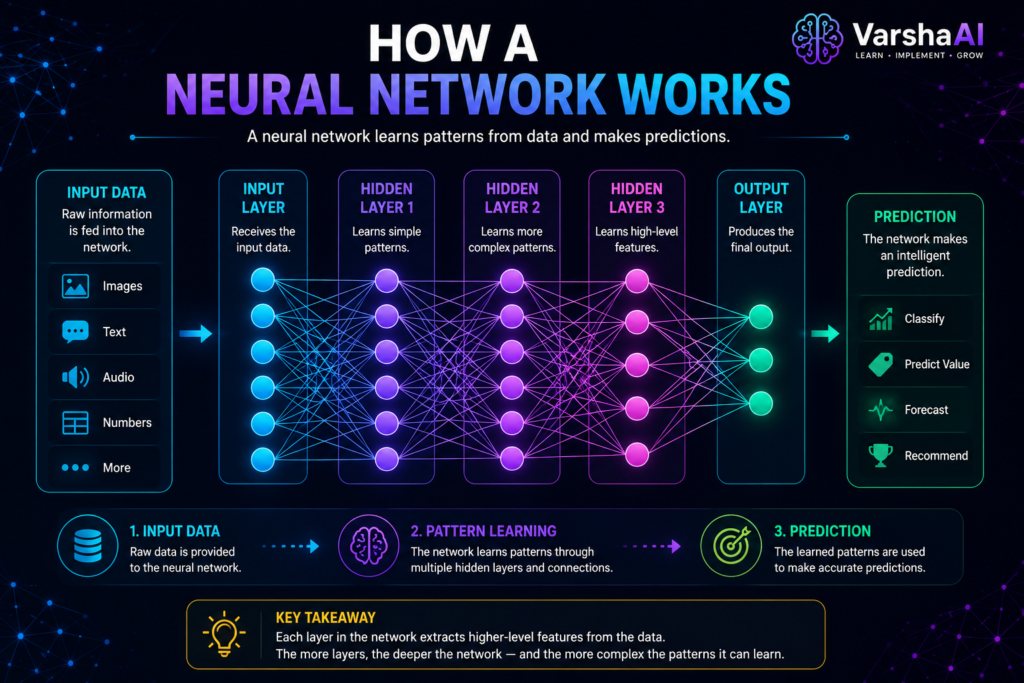
Here’s the simplified structure:
- Input layer — Receives the raw data (like pixel values from an image, or words from a sentence).
- Hidden layers — One or more layers of interconnected nodes (“neurons”) that each perform small calculations and pass results forward. This is where the network gradually detects increasingly complex patterns — early layers might detect edges in an image, deeper layers detect shapes, and even deeper layers detect entire objects.
- Output layer — Produces the final prediction or classification (e.g., “this is a cat,” or “this email is spam”).
Each connection between neurons has a weight, adjusted during training. The network makes a prediction, compares it to the correct answer, calculates how wrong it was, and adjusts its weights slightly to do better next time — a process repeated across millions of examples. This adjustment process is called backpropagation, and it’s the core mechanism that lets deep learning models learn.
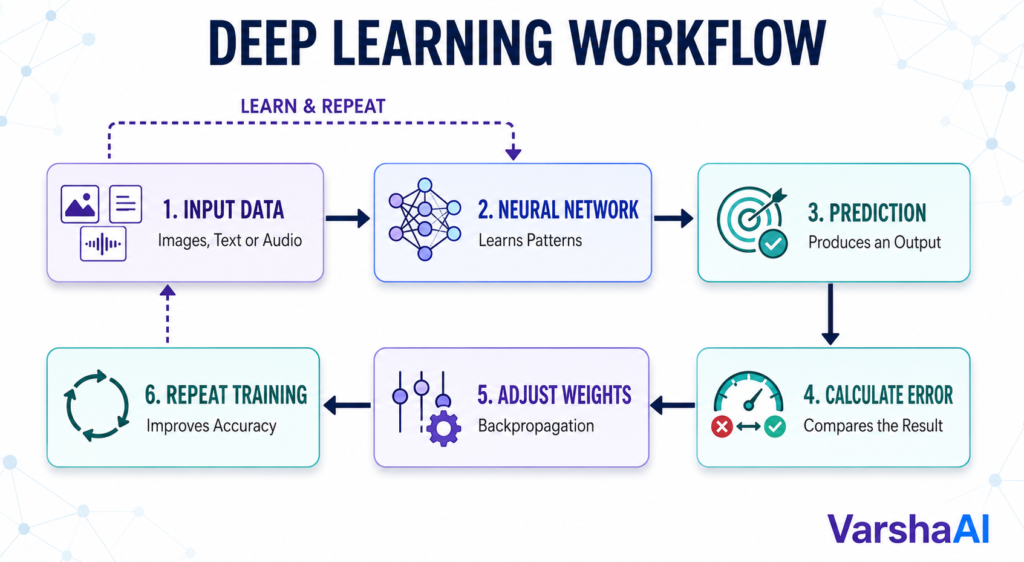
The word “deep” simply refers to having many hidden layers stacked on top of each other. A deeper network can learn increasingly complex representations — but adding more layers doesn’t automatically make a model more accurate; architecture, data quality, and training method all matter too.
Main Types of Neural Network Architectures
Different deep learning tasks use different network designs. You don’t need to memorize the technical details, but recognizing these names will help you follow AI news and tool descriptions:
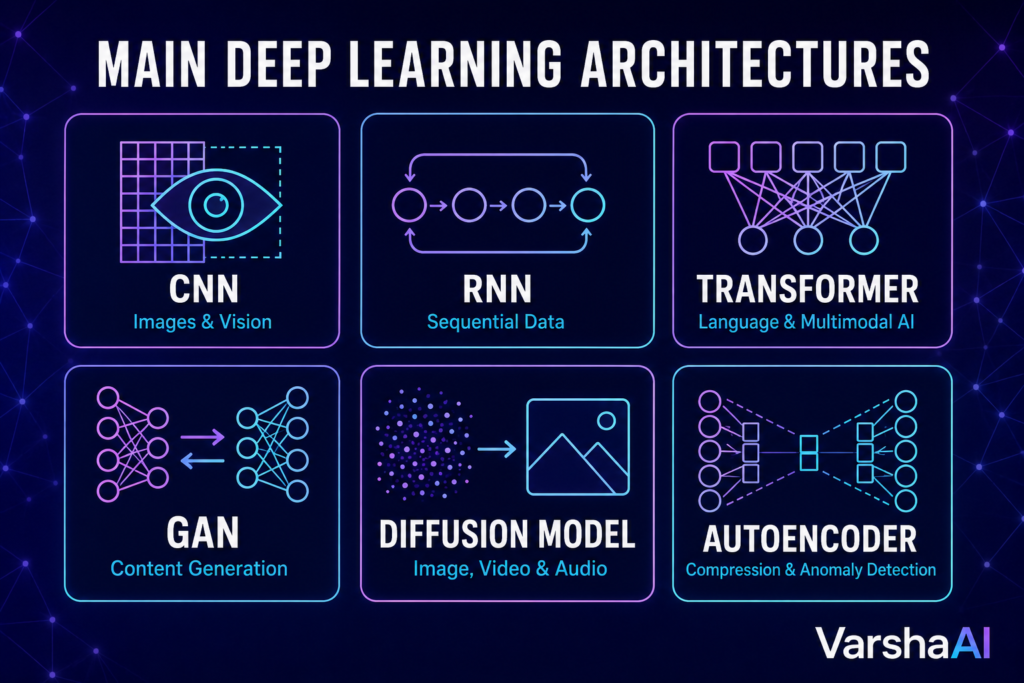
- Convolutional Neural Networks (CNNs) — Specialized for images and computer vision tasks, like recognizing faces or objects in photos.
- Recurrent Neural Networks (RNNs) — Historically used for sequential data such as text, speech, and time series. Today, Transformers are preferred for most language tasks, though RNNs are still used in some smaller or more constrained sequential applications.
- Transformers — The architecture behind modern large language models (like ChatGPT); exceptionally good at understanding context in language and now used far beyond text, including in image and audio models.
- Generative Adversarial Networks (GANs) — Two networks working against each other, one generating content and one judging it, historically common for generating realistic images.
- Diffusion Models — Generative models that create images (and increasingly video and audio) by gradually transforming random noise into meaningful content. They power many of today’s leading AI image-generation systems.
- Autoencoders — Used for compressing and reconstructing data, often applied in noise reduction and anomaly detection.
Multimodal and Foundation Models (2026 Update)
By 2026, many of the most capable AI systems are multimodal, meaning a single model can work across combinations of text, images, audio, and video rather than being limited to one data type. These systems are typically built from large pre-trained foundation models — massive networks trained on broad, general data — which are then adapted to specific tasks through fine-tuning or transfer learning. This is also why deep learning today often needs less task-specific data than it used to: instead of training a new model from scratch, teams frequently start from a pre-trained foundation model and adapt it, which requires a much smaller custom dataset.
Most beginner deep learning courses still start with a basic feedforward neural network before moving on to CNNs and Transformers, since those show up the most in real-world tools today.
Everyday Examples of Deep Learning
Deep learning isn’t confined to research labs — you’re very likely interacting with it multiple times a day:
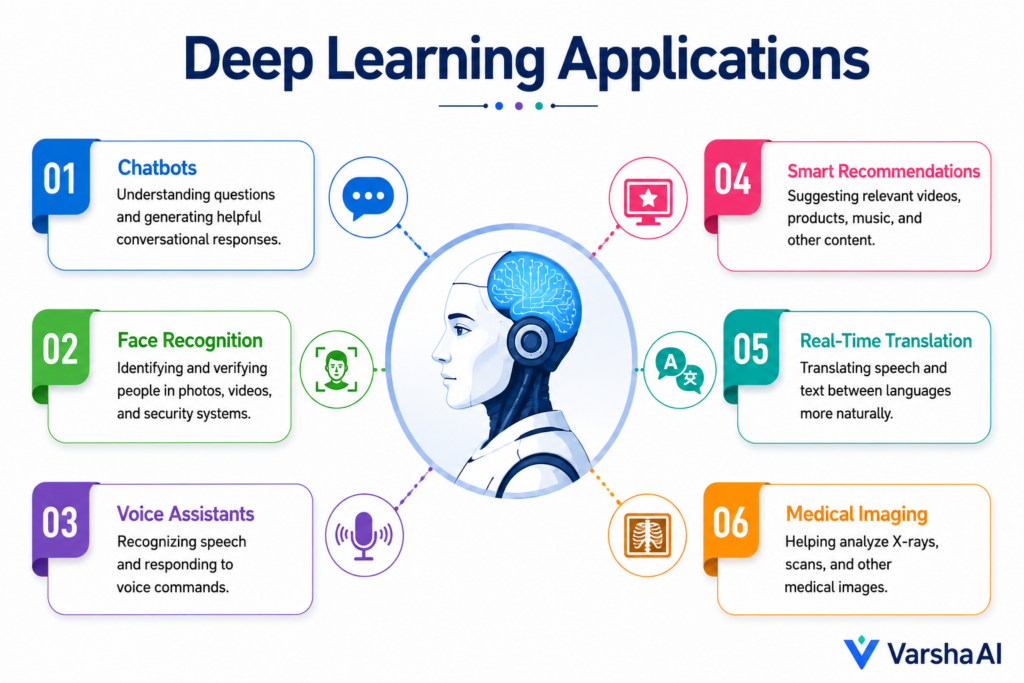
- Chatbots and AI assistants — Tools like ChatGPT use Transformer-based deep learning to understand and generate human-like language.
- Face unlock on smartphones — Uses CNN-based computer vision to recognize your face securely.
- Voice assistants — Siri, Alexa, and Google Assistant rely on deep learning for speech recognition and natural language understanding.
- Photo organization — Apps like Google Photos use deep learning to automatically tag people, places, and objects in your pictures.
- Real-time translation — Apps like Google Translate use deep learning to produce far more natural translations than older rule-based systems.
- Content recommendations — Platforms like YouTube and Netflix use deep learning models to predict what content you’re likely to enjoy next.
- Search intent understanding — Google increasingly uses deep learning to interpret what searchers actually mean, which is part of why SEO for Beginners now emphasizes writing for genuine search intent over exact keyword matching.
Industries Using Deep Learning
Deep learning has moved well beyond tech giants and is now embedded across major industries:
- Healthcare — Analyzing medical images (X-rays, MRIs) to help detect diseases earlier and more accurately.
- Automotive — Powering the computer vision systems behind self-driving and driver-assist technology.
- Finance — Detecting fraud patterns too complex for traditional rule-based systems to catch.
- Retail & E-commerce — Personalized recommendations and demand forecasting based on deep behavioral patterns.
- Marketing — Content generation, predictive analytics, and audience targeting, closely tied to how AI is used for SEO and content strategy today.
- Entertainment — Generating realistic visual effects, voice synthesis, and personalized content feeds.
- Security — Facial recognition and anomaly detection in surveillance and cybersecurity systems.
Advantages and Disadvantages of Deep Learning
Advantages
- Excels at unstructured data — images, audio, and natural language — where traditional ML struggles.
- Automatically learns many useful features from raw data, reducing (though not always eliminating) the need for manual feature engineering.
- Improves as more training data and computing power become available, and increasingly benefits from transfer learning on smaller task-specific datasets.
- Powers today’s most capable AI systems, from chatbots to computer vision tools.
Disadvantages
- Training a model from scratch typically requires large datasets and significant computing power.
- Training can be slow and expensive, especially for large models.
- Decisions are often difficult to explain — commonly called the “black box” problem — which matters in regulated fields like healthcare and finance.
- Can inherit and amplify biases present in its training data, sometimes in subtle ways that are hard to detect.
Understanding these trade-offs is part of why simpler machine learning models are still preferred for many business problems — deep learning is powerful, but it isn’t always the right or most efficient tool for the job.
Career Opportunities in Deep Learning
Deep learning has created a fast-growing set of specialized career paths within the broader AI and data science field:
- Deep Learning Engineer — Designs, trains, and deploys neural network models for specific applications.
- Computer Vision Engineer — Focuses specifically on image and video-based deep learning applications.
- NLP Engineer — Specializes in language-based deep learning, including chatbots and Transformer-based models.
- AI Research Scientist — Develops new neural network architectures and techniques, often in academic or corporate research labs.
- MLOps Engineer — Focuses on deploying and maintaining deep learning models reliably in production environments.
Even outside these dedicated roles, understanding deep learning is increasingly valuable across marketing, product, and content careers, since so many modern tools are built directly on top of it — see How to Use ChatGPT for Digital Marketing for a practical example.
How Beginners Can Start Learning Deep Learning
You don’t need to jump straight into building neural networks — a structured path makes this far more approachable:
- Get comfortable with machine learning basics first. Deep learning builds directly on ML concepts like training data, model accuracy, and classification.
- Learn basic Python. Python remains the standard language for deep learning, thanks to libraries built specifically for it.
- Understand neural networks conceptually before coding. Grasp the idea of layers, weights, and backpropagation before touching a framework.
- Try beginner-friendly frameworks. Tools like TensorFlow and PyTorch (with tutorials) are the industry standard for building deep learning models.
- Practice with small, well-known datasets. Beginner projects like handwritten digit recognition are a common, approachable starting point.
- Study one architecture at a time. Start with basic feedforward networks, then move to CNNs, then Transformers, and finally explore diffusion and multimodal models.
Most beginners can understand the core ideas within a few weeks. Becoming genuinely proficient at building and training deep learning models typically takes several months of consistent, hands-on practice.
For a more technical, structured introduction, university-published course materials — such as Stanford’s CS231n (computer vision) and CS224n (NLP) lecture notes — remain solid, widely-cited starting points once you’re past the beginner stage.
Common Deep Learning Myths (Beginners, Take Note)
- “Deep learning and machine learning are the same thing.” Deep learning is a specific, more specialized subset of machine learning.
- “Deep learning models think like humans.” Neural networks are loosely inspired by the brain but work through statistical pattern matching, not genuine understanding or reasoning.
- “You need a supercomputer to learn deep learning.” Beginner-level learning and small projects can be done on free cloud platforms like Google Colab.
- “Deep learning always outperforms simpler machine learning.” For smaller datasets or simpler problems, traditional ML models are often more accurate, faster, and easier to explain.
- “Deep learning models are always right.” Like any ML system, reliability depends on training data, model design, training methods, testing, and the conditions in which the model is used — not on data alone.
Why Should Beginners in Marketing or Blogging Care About This?
If you’re building skills in digital marketing, SEO, or blogging, deep learning already shapes the tools and platforms you use daily:
- The AI writing assistants used in content creation and tools like ChatGPT are built on Transformer-based deep learning models.
- Google’s search algorithms increasingly use deep learning to understand nuanced search intent, not just keyword matches.
- Ad platforms use deep learning to predict user behavior far more precisely than older, rule-based targeting systems.
Understanding deep learning at a conceptual level helps you use these tools with realistic expectations, instead of assuming they “understand” content the way a human does.
FAQs
What is deep learning in simple words? Deep learning is a type of machine learning that uses layered neural networks to learn patterns directly from large amounts of raw data, like images, audio, or text.
Is deep learning the same as machine learning? No. Deep learning is a specialized subset of machine learning that uses multi-layered neural networks, while machine learning is the broader category that includes simpler methods too.
Does ChatGPT use deep learning? Yes. ChatGPT is built on a large language model using the Transformer architecture, a form of deep learning.
Do I need a powerful computer to learn deep learning? Not for beginner learning. Free cloud platforms like Google Colab provide enough computing power for small projects and tutorials.
What is a neural network? A layered structure of connected nodes, loosely inspired by neurons in the brain, that processes data through an input layer, one or more hidden layers, and an output layer.
What’s the difference between a CNN and an RNN? CNNs are designed for image and visual data, while RNNs are designed for sequential data like text or time-series information where order matters — though Transformers now handle much of that sequential work too.
Why is it called “deep” learning? It refers to having many hidden layers stacked in the neural network — the more layers, the “deeper” the network.
Can deep learning work without a lot of data? Training a model from scratch usually requires substantial data. However, transfer learning and pre-trained foundation models can produce good results with much smaller task-specific datasets.
Is deep learning better than machine learning? Not always. Deep learning excels with large, unstructured datasets, but traditional machine learning is often faster, cheaper, and more explainable for smaller or simpler problems.
Can deep learning replace humans? Not in any general sense. It can automate specific, well-defined tasks very effectively, but it doesn’t understand or reason the way a person does, even when its output looks intelligent — it’s performing pattern recognition, not genuine judgment.
Key Takeaways
- Deep learning is a subset of machine learning that uses multi-layered neural networks to learn directly from raw data.
- It excels at unstructured data — images, audio, and language — where traditional machine learning struggles.
- Modern AI tools like ChatGPT, image generators, and voice assistants are all built on deep learning architectures, increasingly multimodal and built on shared foundation models.
- Training a model from scratch requires large datasets and significant computing power, though transfer learning has lowered that bar considerably.
- You don’t need to build models yourself to benefit — understanding the basics helps you use AI tools more effectively and with realistic expectations.
Conclusion
Deep learning isn’t a separate mystery sitting apart from AI and machine learning — it’s the specialized, layered approach that finally let machines handle messy, real-world data like images, speech, and language at a genuinely useful level. Once you understand the basic idea of layered neural networks learning directly from raw data, tools like ChatGPT and voice assistants stop feeling like magic and start making a lot more practical sense.
Your Next Step: Now that you understand both machine learning and deep learning, the natural next step is seeing these concepts in action inside real tools — explore our guide on 10 Best AI Tools for Digital Marketing to see deep learning-powered tools at work.