SEO is evolving faster than ever.
What worked a few years ago may not be enough today. Search engines have become smarter, competition has increased, and users now expect more relevant and valuable content than ever before.
As a result, marketers are constantly looking for better ways to improve rankings, attract organic traffic, and stay ahead of competitors.
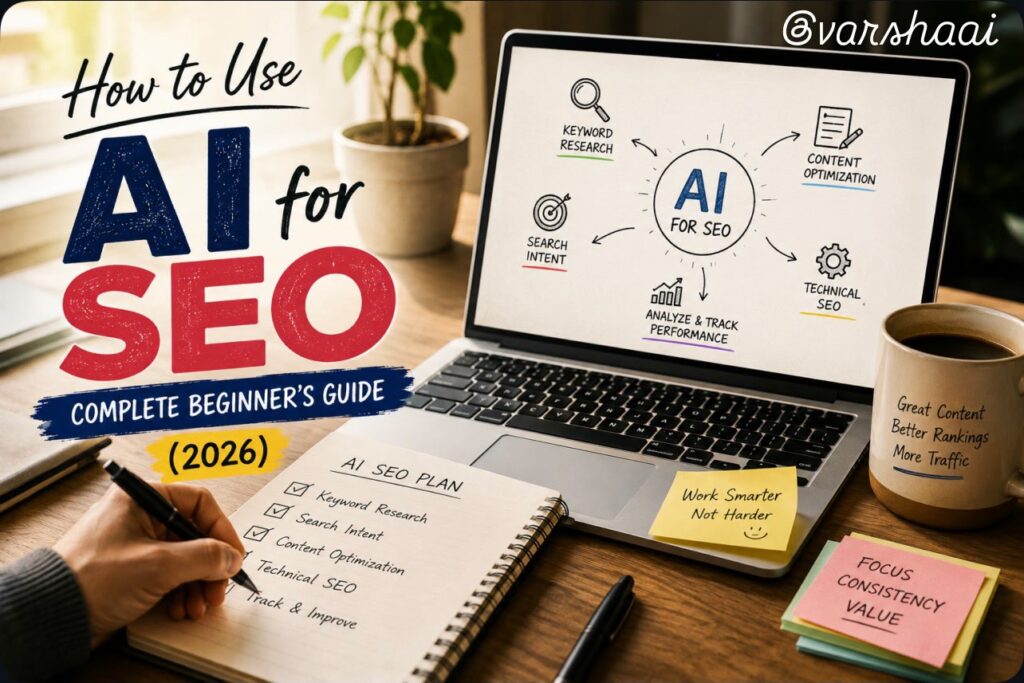
This is one of the biggest reasons why AI for SEO is gaining attention.
From keyword research and content planning to competitor analysis and optimization, AI-powered tools are helping marketers work more efficiently and make smarter decisions based on data rather than guesswork.
However, AI is not a magic solution.
The most successful SEO strategies still rely on human creativity, expertise, and a deep understanding of user intent. AI simply helps marketers save time, uncover opportunities, and focus on high-impact activities.
Whether you’re a blogger, freelancer, digital marketer, or business owner, learning how to use AI effectively can help you improve your SEO strategy and achieve better results.
In this guide, you’ll learn what AI for SEO is, how it works, its key benefits, the best tools to use, common mistakes to avoid, and future trends that are shaping the search industry.
What is AI for SEO?
AI for SEO means using Artificial Intelligence tools to make search engine optimization faster, smarter, and more efficient.
Instead of spending hours manually analyzing data, marketers can use AI-powered tools to identify opportunities, uncover insights, and improve their SEO strategies.
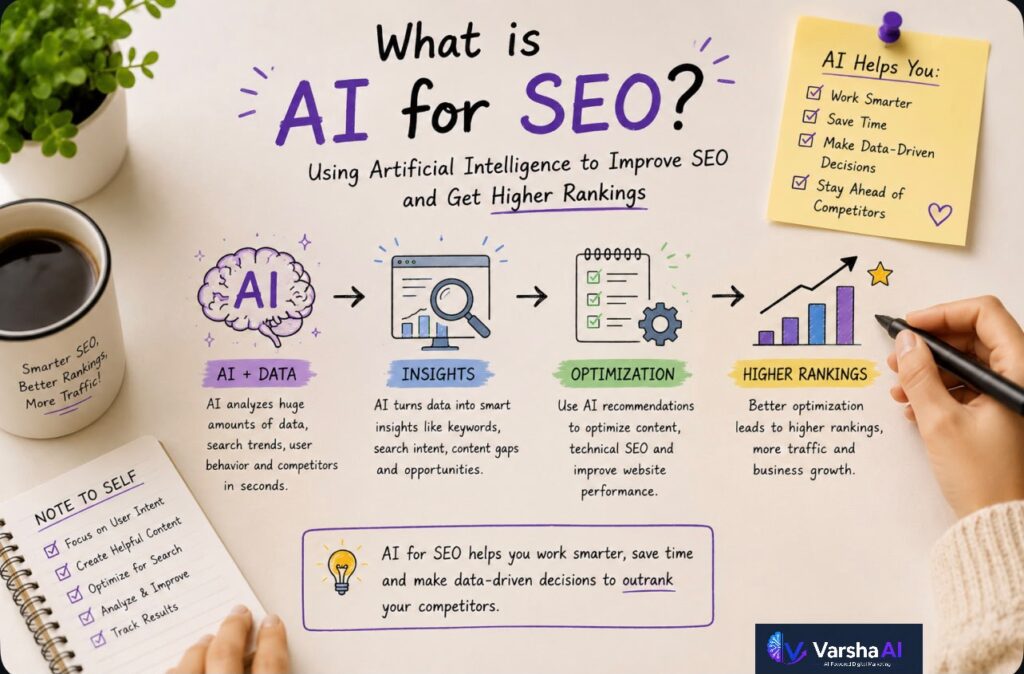
AI can help with:
- Keyword research
- Search intent analysis
- Content planning
- On-page optimization
- Competitor research
- Technical SEO audits
- Performance tracking
For example, a keyword research process that may take several hours can often be completed in minutes with the help of AI tools.
However, AI is not a replacement for SEO expertise. The best results come when AI is combined with human creativity, strategic thinking, and industry knowledge.
AI for SEO helps marketers work smarter, analyze data faster, and optimize websites more effectively.
Traditional SEO vs AI-Assisted SEO
To understand the value of Artificial Intelligence in search optimization, it helps to compare traditional SEO methods with modern AI-assisted workflows.
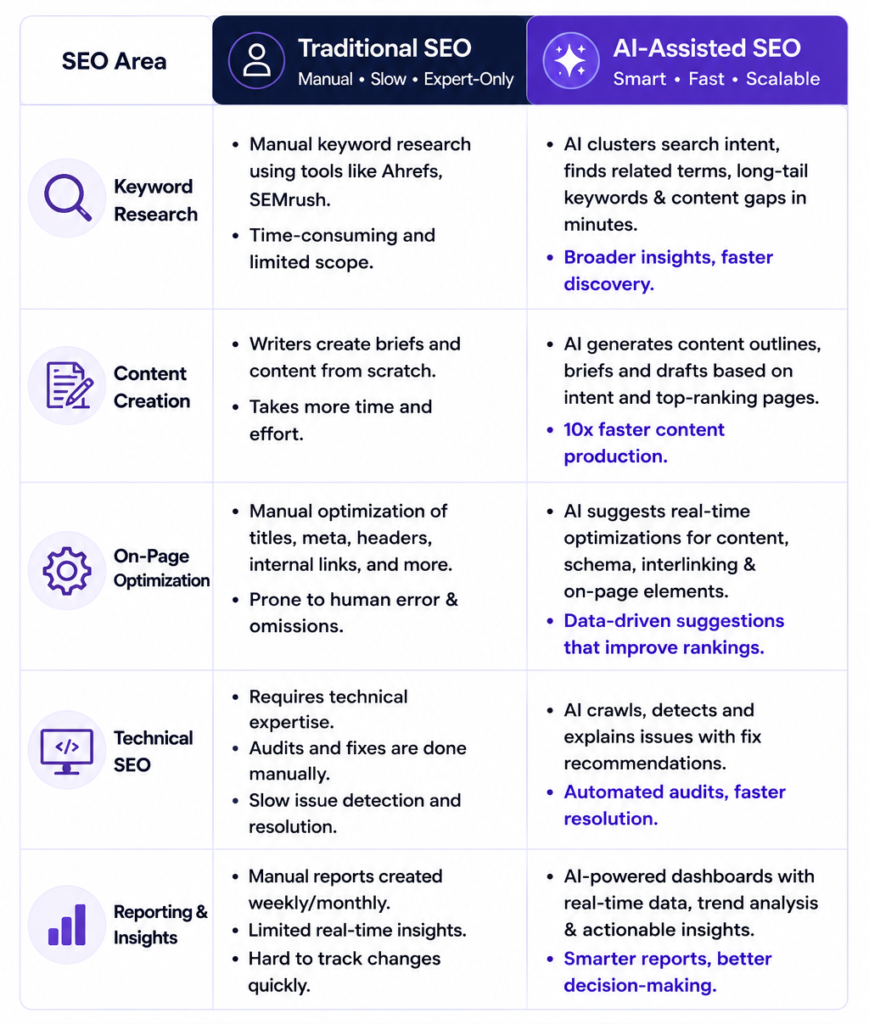
While traditional SEO skills remain important, AI provides an additional layer of efficiency that allows marketers to make better decisions more quickly.
The goal is not to replace SEO fundamentals.
The goal is to improve them.
Why AI is Changing SEO
SEO is no longer just about adding keywords to a page and hoping for rankings. As search engines become smarter and competition continues to grow, businesses need faster and more efficient ways to optimize their content.
This is one of the biggest reasons why AI for SEO is becoming a game-changer for modern marketers.
Modern ranking systems analyze:
- User intent
- Content quality
- Relevance
- Authority
- User experience
- Engagement signals
As a result, SEO has become increasingly complex.
Artificial Intelligence helps simplify this complexity by processing large amounts of information and identifying actionable insights.
1. Faster Data Analysis
SEO generates enormous amounts of data.
Marketers need to analyze:
- Keywords
- Rankings
- Competitors
- Search trends
- User behavior
AI can process this information far faster than manual methods.
This allows businesses to identify opportunities before competitors do.
2. Better Understanding of Search Intent
One of the most important ranking factors today is search intent.
Search engines want to understand why users perform a search.
AI tools help marketers identify whether users are looking for:
- Information
- Products
- Services
- Comparisons
- Solutions
Understanding intent helps create content that better satisfies user needs.
3. Smarter Content Planning
Creating content without research often leads to poor results.
AI helps marketers discover:
- Popular topics
- Related questions
- Content gaps
- Trending search queries
This makes content planning more strategic and data-driven.
4. Increased Productivity
Many SEO tasks are repetitive.
AI helps automate processes such as:
- Topic generation
- Content optimization
- SEO audits
- Data reporting
This allows marketers to focus on strategy rather than repetitive work.
Benefits of Using AI in SEO
As SEO becomes more competitive, marketers are constantly looking for smarter ways to improve their results. This is one of the main reasons why AI is gaining popularity across the industry. From finding keyword opportunities to optimizing content and analyzing competitors, AI helps simplify many time-consuming SEO tasks.
Faster Keyword Research
Keyword research can often take hours, especially when you’re trying to identify the right search terms and understand user intent. AI speeds up this process by analyzing search trends, user behavior, and keyword opportunities in seconds.
As a result, marketers can focus more on strategy and less on manual research.
Improved Content Quality
Creating content that ranks well requires more than just adding keywords. AI can help improve content structure, readability, relevance, and optimization suggestions.
These insights make it easier to create content that is both search-engine friendly and genuinely useful for readers.
Better Competitor Analysis
Keeping an eye on competitors is an important part of any SEO strategy. AI tools can quickly identify top-performing pages, content gaps, ranking trends, and keyword opportunities.
This allows marketers to learn from competitors and discover areas where they can gain an advantage.
More Efficient Workflows
Many SEO tasks involve repetitive work that can consume a significant amount of time. AI helps automate parts of the process, making workflows faster and more efficient.
Tasks that once took hours can often be completed in a matter of minutes.
Better Decision Making
One of the biggest advantages of AI is its ability to analyze large amounts of data quickly. Instead of relying on assumptions, marketers can make decisions based on real insights and performance trends.
This often leads to more effective SEO strategies and better long-term results.
How to Use AI for SEO: A Step-by-Step Guide
Understanding the theory is important, but the real value comes from applying AI in your daily SEO workflow.
The good news is that you do not need advanced technical skills to get started.
Below is a practical framework that beginners can follow.
Step 1: Use AI for Keyword Research
Keyword research is the foundation of every successful SEO strategy.
Before creating content, you need to understand what your audience is searching for.
AI-powered tools can help identify:
- High-potential keywords
- Long-tail keywords
- Related search terms
- Frequently asked questions
- Content opportunities
For example:
Instead of targeting a broad keyword like:
SEO
You may discover valuable long-tail variations such as:
- How to use AI for SEO
- Best AI SEO tools
- AI content optimization
- AI keyword research tools
Long-tail keywords are often easier to rank for and attract more targeted visitors.
Best Tools for Keyword Research
- ChatGPT
- Google Gemini
- Semrush
- Ahrefs
- Google Search Console
These tools help marketers discover opportunities faster than traditional research methods.
Step 2: Analyze Search Intent
One of the biggest SEO mistakes is targeting keywords without understanding search intent.
Search intent refers to the reason behind a search query.
Generally, there are four types of search intent:
Informational Intent
Users want information.
Examples:
- What is SEO?
- What is Artificial Intelligence?
- How does AI work?
Navigational Intent
Users are looking for a specific website or brand.
Examples:
- OpenAI
- Google Search Console
Commercial Intent
Users are comparing options before making a decision.
Examples:
- Best AI SEO tools
- Semrush vs Ahrefs
Transactional Intent
Users are ready to buy.
Examples:
- Buy SEO software
- SEO agency services
AI tools can help identify the intent behind keywords so that content matches what users expect.
This improves both rankings and engagement.
Step 3: Create Better Content Plans
Many blogs fail because content is created without a clear strategy.
AI helps marketers create stronger content plans by analyzing:
- Competitor articles
- Related questions
- Search trends
- Topic clusters
For example:
If you are writing about SEO, AI may suggest related topics such as:
- Keyword research
- Technical SEO
- Content marketing
- Link building
- SEO tools
This helps create comprehensive content that covers a topic in depth.
Google often rewards content that fully answers user questions.
Step 4: Optimize Content Before Publishing
Creating content is only the first step.
Optimization is equally important.
AI tools can review content and suggest improvements such as:
- Better headings
- Improved readability
- Missing keywords
- Internal linking opportunities
- Meta description suggestions
For example:
If your article lacks a commonly searched subtopic, AI tools may recommend adding it before publishing.
This helps improve content quality and search visibility.
Important Tip
Never publish AI-generated content without reviewing it.
Always:
- Fact-check information
- Improve clarity
- Add personal insights
- Include real examples
Human expertise remains essential.
Step 5: Perform Competitor Analysis
Competitor analysis is one of the most valuable uses of Artificial Intelligence in SEO.
Instead of manually reviewing dozens of websites, AI tools can quickly analyze:
- Competitor keywords
- Top-performing pages
- Content gaps
- Backlink opportunities
This information helps identify areas where your competitors are succeeding and where opportunities exist.
Ask questions such as:
- What topics are competitors ranking for?
- Which keywords are driving traffic?
- What content is missing from my website?
Answering these questions helps create a stronger SEO strategy.
Step 6: Improve Technical SEO
Technical SEO plays an important role in website performance.
Even great content may struggle to rank if technical issues exist.
AI tools can help identify:
- Broken links
- Slow page speed
- Missing meta tags
- Crawl errors
- Duplicate content
- Mobile usability issues
Regular technical audits help ensure that search engines can easily understand and index your website.
A Practical AI SEO Workflow
Many beginners wonder how professionals actually use Artificial Intelligence in their SEO process.
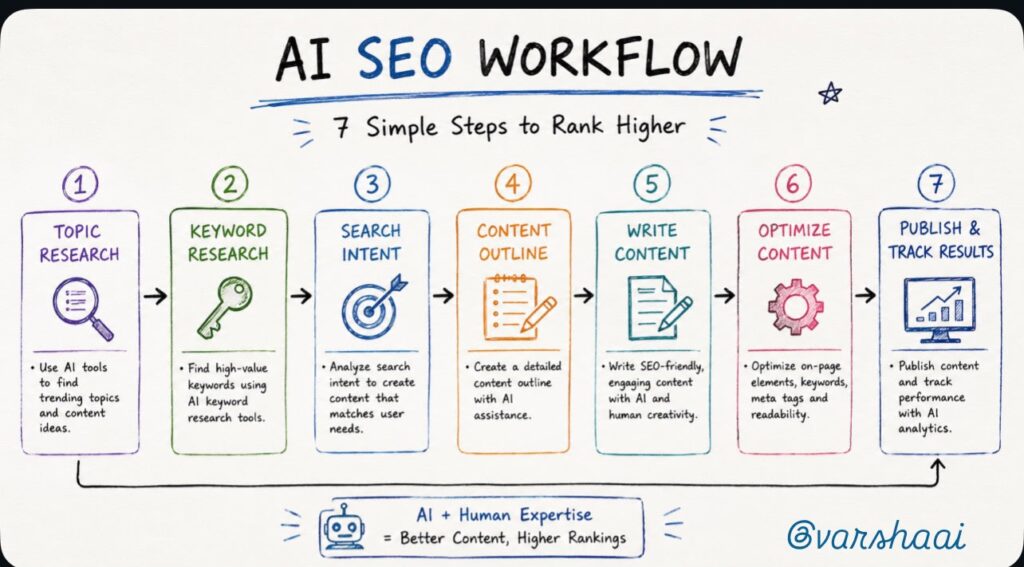
A simple workflow may look like this:
Step 1
Research topics using ChatGPT or Google Gemini.
Step 2
Validate keyword opportunities using Google Search Console, Ahrefs, or Semrush.
Step 3
Analyze search intent.
Step 4
Create a detailed content outline.
Step 5
Write high-quality content.
Step 6
Use AI tools for optimization suggestions.
Step 7
Add internal links to relevant content.
For example:
You can link to:
- What is Artificial Intelligence (AI)?
- What is Digital Marketing?
- What is AI Powered Digital Marketing?
Step 8
Publish and monitor performance using Google Analytics and Search Console.
This workflow combines the speed of AI with the strategic thinking of human marketers.
The result is a more effective and scalable SEO process.
Best AI SEO Tools for Beginners
Choosing the right tools can significantly improve your SEO efforts.
Below are some of the most useful options.
ChatGPT
Best for:
- Content ideas
- Topic research
- Outline generation
- Keyword brainstorming
Google Gemini
Best for:
- Research assistance
- Content planning
- Search insights
Google Search Console
Best for:
- Tracking rankings
- Monitoring search performance
- Identifying keyword opportunities
Google Analytics 4
Best for:
- User behavior analysis
- Traffic tracking
- Conversion monitoring
Ahrefs
Best for:
- Keyword research
- Backlink analysis
- Competitor research
Semrush
Best for:
- SEO audits
- Competitor analysis
- Keyword tracking
Surfer SEO
Best for:
- Content optimization
- On-page SEO recommendations
The best approach is to combine multiple tools rather than relying on a single platform.
Common AI SEO Mistakes to Avoid
Artificial Intelligence can significantly improve SEO performance, but relying on it incorrectly can create problems.
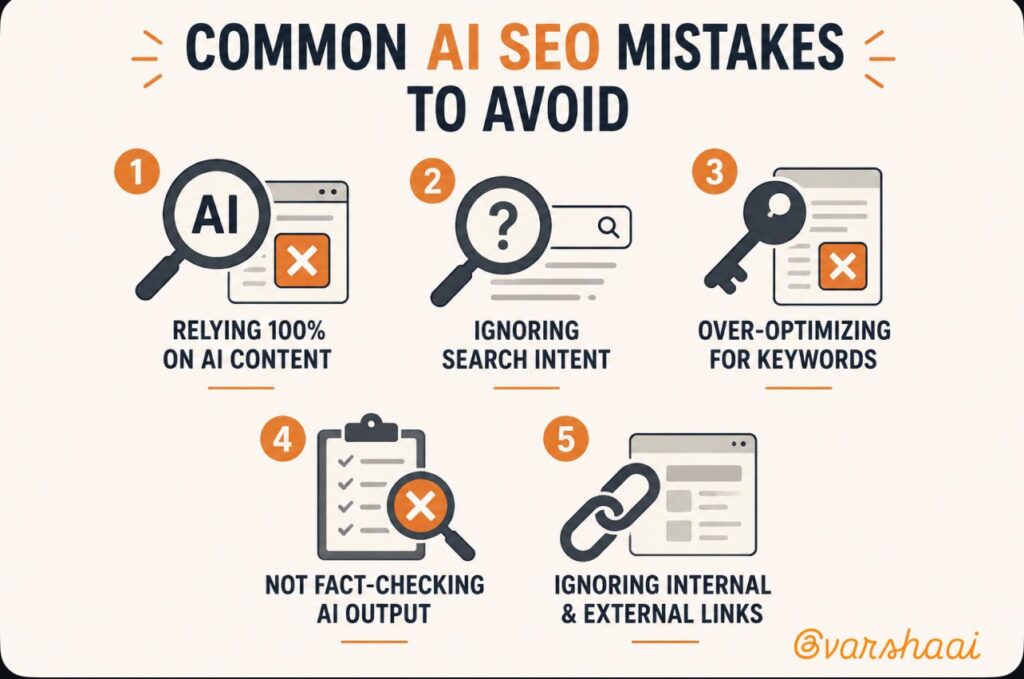
Below are some of the most common mistakes beginners make.
1. Publishing AI Content Without Editing
One of the biggest mistakes is generating content and publishing it immediately.
AI can help create drafts, but it may:
- Miss context
- Include outdated information
- Produce generic content
- Lack originality
Always review, edit, and improve content before publishing.
2. Ignoring Search Intent
Many marketers focus only on keywords.
However, ranking success depends on understanding why users are searching for something.
If your content does not satisfy search intent, rankings may suffer regardless of keyword usage.
3. Keyword Stuffing
Some beginners overuse keywords because they believe it improves rankings.
Modern SEO focuses on relevance and user experience.
Use keywords naturally and prioritize helpful content.
4. Relying Entirely on AI
Artificial Intelligence is a powerful assistant, but it should not replace human expertise.
The most successful SEO strategies combine:
- AI insights
- Human creativity
- Industry knowledge
- Strategic thinking
5. Skipping Fact Checking
AI tools occasionally generate incorrect information.
Always verify:
- Statistics
- Facts
- Case studies
- Industry claims
Accuracy helps build trust and credibility.
The Future of AI in SEO
Artificial Intelligence is already transforming SEO, and its influence will continue to grow in the coming years.
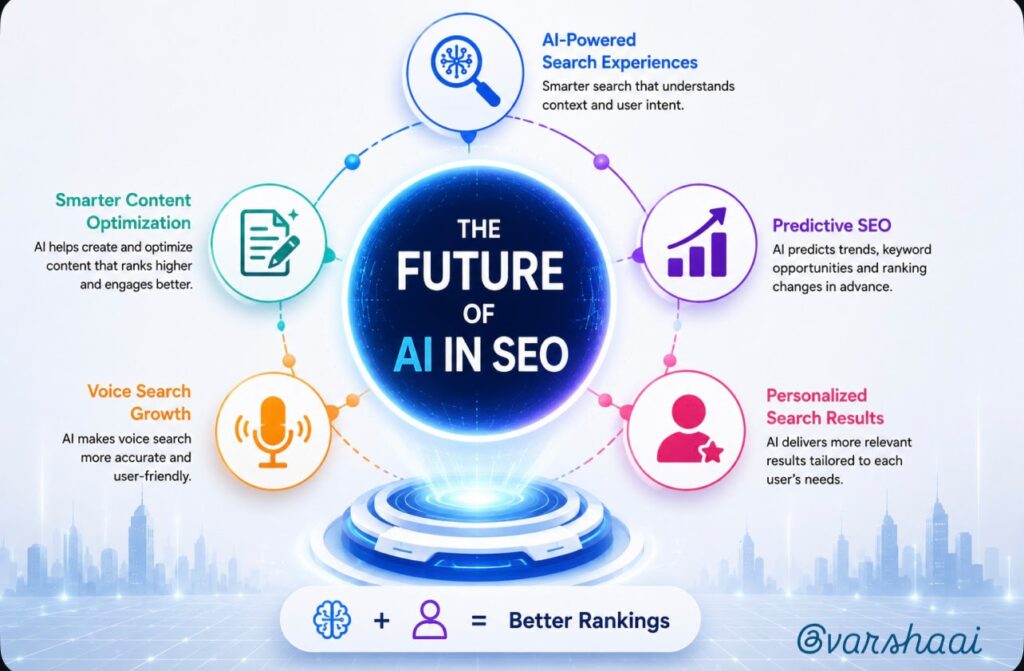
Businesses that understand these changes early will have a competitive advantage.
AI-Powered Search Experiences
Search engines are becoming more intelligent.
Instead of simply matching keywords, they increasingly focus on understanding user intent and delivering direct answers.
This means content must become more helpful, accurate, and comprehensive.
Smarter Content Optimization
Future AI tools will provide even better recommendations for:
- Content quality
- User engagement
- Search intent alignment
- Content structure
This will help marketers create stronger content more efficiently.
Predictive SEO
Predictive SEO is an emerging trend where AI analyzes historical data and search patterns to forecast future opportunities.
This allows businesses to create content before search demand peaks.
Voice Search Growth
As voice assistants become more popular, marketers will need to optimize content for conversational search queries.
AI can help identify these opportunities and improve visibility in voice search results.
Personalized Search Results
Search engines are moving toward more personalized experiences.
AI will play an important role in helping businesses understand audience behavior and create more relevant content.
The future of SEO will not be about replacing humans with AI.
Instead, it will be about combining human expertise with Artificial Intelligence to create better experiences for users.
Frequently Asked Questions (FAQ)
Q1. What is AI for SEO?
AI for SEO refers to using Artificial Intelligence tools and technologies to improve search engine optimization processes such as keyword research, content optimization, competitor analysis, and technical audits.
Q2. Is AI for SEO Good?
Yes.
When used correctly, Artificial Intelligence can improve efficiency, save time, and help marketers make better SEO decisions.
However, human expertise is still important.
Q3. Can AI replace SEO professionals?
No.
AI can automate tasks and provide recommendations, but strategy, creativity, and decision-making still require human involvement.
The best results come from combining AI tools with SEO expertise.
Q4. What are the best AI SEO tools for beginners?
Popular options include:
- ChatGPT
- Google Gemini
- Google Search Console
- Google Analytics 4
- Ahrefs
- Semrush
- Surfer SEO
Q5. Does Google allow AI-generated content?
Yes.
Google focuses on content quality rather than how content is created.
As long as content is helpful, accurate, and valuable for users, AI-assisted content can perform well.
Q6. Can small businesses use AI for SEO?
Absolutely.
Many free and affordable tools make it possible for small businesses to improve SEO without hiring large teams.
Q7. What is the biggest benefit of using AI in SEO?
The biggest advantage is efficiency.
AI helps marketers analyze data faster, discover opportunities, and optimize content more effectively.
Q8. Is AI useful for keyword research?
Yes.
AI tools can identify keyword opportunities, related search terms, long-tail keywords, and search intent insights that help improve content planning.
Conclusion
SEO is becoming more competitive every year, and keeping up with changing search trends can be challenging. This is where AI for SEO can make a real difference.
From keyword research and competitor analysis to content optimization and technical audits, AI for SEO helps marketers work more efficiently and make smarter decisions based on data.
At the same time, it’s important to remember that AI is a tool—not a replacement for experience, creativity, and strategic thinking.
The most successful marketers use AI to support their workflow while continuing to focus on creating valuable content that genuinely helps their audience.
Whether you’re a blogger, freelancer, digital marketer, or business owner, learning how to use AI for SEO effectively can give you a significant advantage in today’s competitive search landscape.
As AI technology continues to improve, businesses that embrace AI for SEO while maintaining a strong focus on quality and user experience will be in a better position to achieve long-term SEO success.