If you’ve ever wondered how Netflix always seems to know what you want to watch next, or how your email quietly filters out spam before you even see it — that’s machine learning working in the background. It’s one of the most talked-about pieces of AI, yet most beginners still find it confusing because it gets explained with jargon before the basics are clear.
If you’re wondering “What is Machine Learning?”, this beginner’s guide explains everything you need to know in simple language. By the end, you’ll understand exactly what machine learning is, how it actually works, where you already use it every day, and how it’s different from the broader term “AI.” If you haven’t already, it’s worth reading What is Artificial Intelligence (AI)? first, since machine learning is really just one part of that bigger picture.
A quick note from experience: When I first started exploring AI tools, I assumed machine learning and artificial intelligence were the same thing — most beginners do. It wasn’t until I started experimenting with tools like ChatGPT, recommendation engines, and basic data-science exercises that it clicked: machine learning isn’t a separate technology sitting next to AI, it’s the actual engine powering most of the AI applications we use daily. Once that distinction made sense, everything else about AI became far easier to follow.
What You’ll Learn
Understanding what is Machine Learning is important because it powers many of the AI tools we use every day, from recommendation systems to voice assistants and fraud detection.
- What machine learning actually means, in plain language
- A short history of how machine learning developed
- How machine learning is different from traditional programming
- The three main types of machine learning, and the algorithms behind them
- A detailed timeline of how an ML model is actually built
- Real, everyday examples and industries using machine learning
- Advantages and disadvantages of machine learning
- Career opportunities and how beginners can start learning ML
- Common beginner myths and mistakes
What Is Machine Learning?
Machine learning (ML) is a branch of artificial intelligence where a computer learns to make decisions or predictions by finding patterns in training data — instead of being given step-by-step instructions for every situation.
Here’s the simplest way to think about it: with traditional software, a programmer writes exact rules (“if this happens, do that”). With machine learning, you instead show the computer thousands of examples, and it figures out the rules on its own using statistical patterns.
For example, instead of writing rules to define what a “spam email” looks like, you feed a machine learning model thousands of emails already labeled as spam or not spam. Over time, it learns the patterns — certain words, sender behaviors, formatting — and starts recognizing spam in emails it has never seen before. This kind of task, where the model sorts things into categories, is called classification — one of the most common jobs machine learning is used for.
A Short History of Machine Learning
Machine learning feels like a recent trend, but its roots go back much further than most people expect:
- 1950s: Alan Turing raised the question of whether machines could “think,” laying the philosophical groundwork for AI and ML.
- 1959: Arthur Samuel coined the term “machine learning” while building a checkers-playing program that improved itself through repeated play.
- 1980s–90s: Neural networks and early artificial neural networks research advanced, though limited computing power kept practical use cases small.
- 2000s: The explosion of internet data gave ML models far more training data to learn from, improving accuracy dramatically.
- 2012 onward: Breakthroughs in deep learning (especially in computer vision) proved neural networks could outperform older methods at large-scale tasks like image recognition.
- 2020s: Large language models, built using deep learning and massive datasets, brought machine learning into everyday consumer tools like ChatGPT — which is what most beginners now think of first when they hear “AI.”
Understanding this timeline helps explain why machine learning suddenly feels everywhere: it’s not new, but the data and computing power needed to make it genuinely useful only recently caught up.
Machine Learning vs. Traditional Programming
This is the distinction that trips up most beginners, so it’s worth slowing down here.
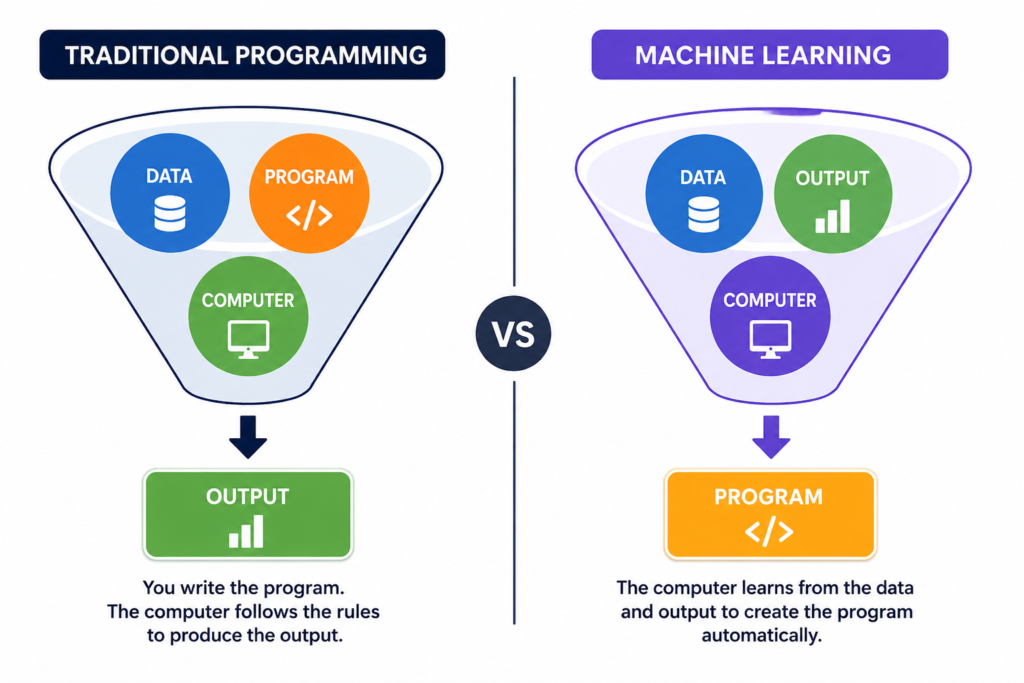
Traditional programming: Rules + Data → Answers A developer writes the rules by hand, and the program applies them to data to produce a result.
Machine learning: Data + Answers → Rules You give the system lots of examples (data) along with the correct answers, and the system works out the rules (the model) itself.
This is why machine learning is so powerful for problems that are too complex or constantly changing for a human to write exact rules for — like recognizing faces in photos, predicting which product you’ll want next, or understanding spoken language through natural language processing (NLP).
How Machine Learning Actually Works: A Step-by-Step Timeline
At a basic level, every machine learning system goes through the same general lifecycle. Here’s a more detailed breakdown of what actually happens at each stage:
- Define the problem — Decide exactly what you want the model to predict or classify (e.g., “will this customer churn?”).
- Collect data — Gather large amounts of relevant training data (images, text, numbers, behavior logs, etc.). This stage often takes the longest in real projects.
- Clean and prepare the data — Remove errors, fill gaps, and organize the data so the model can actually learn from it.
- Feature engineering — Select or create the specific data points (called “features”) that are most useful for making accurate predictions. This step has a huge impact on final model accuracy.
- Train the model — The system studies the data and adjusts itself internally to find patterns connecting inputs to correct outputs.
- Test and evaluate — The model is checked against new data it hasn’t seen, to measure accuracy and catch errors before deployment.
- Tune and improve — Adjustments are made to improve performance, often by feeding in more or better-quality data.
- Deploy — The finished model is put to work in a real product or service, and often keeps learning as it sees more real-world data over time.
You don’t need to understand the math behind this to use ML-powered tools — but understanding this flow makes it much easier to grasp why “more data” and “better data” are such a big deal in AI and data science conversations.
The 3 Main Types of Machine Learning
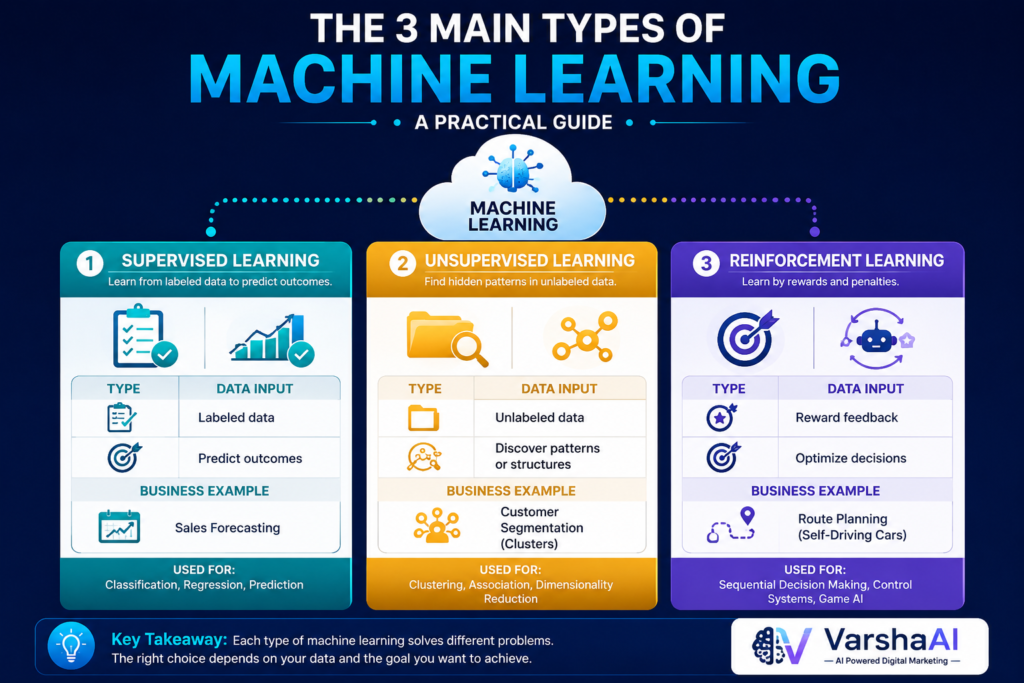
1. Supervised Learning
The model is trained on labeled data — meaning each example already has the “correct answer” attached. This is the most common type used in beginner-friendly tools, and it covers both classification (sorting into categories) and regression (predicting a number).
Example: Training a model on thousands of house listings labeled with their actual sale price, so it learns to predict prices for new listings — a classic regression problem.
2. Unsupervised Learning
The model is given data with no labels and has to find patterns or groupings on its own. This is commonly used for predictive analytics and customer segmentation.
Example: Grouping customers into segments based on shopping behavior, without telling the system in advance what those groups should be.
3. Reinforcement Learning
The model learns by trial and error, receiving “rewards” for good decisions and “penalties” for bad ones — similar to how you’d train a pet with treats.
Example: This is how AI systems learn to play games at a superhuman level, or how robots learn to walk by continuously adjusting after each attempt.
Popular Machine Learning Algorithms (Beginner Overview)
You don’t need to master these to understand machine learning conceptually, but recognizing these names will help you follow along in AI news, tool descriptions, and courses:
- Linear Regression — Predicts a continuous number (like price or temperature) based on input data.
- Logistic Regression — Despite the name, used for classification tasks like “spam or not spam.”
- Decision Trees — Makes decisions by splitting data into branches based on yes/no questions, similar to a flowchart.
- Random Forest — Combines many decision trees together to make more accurate, stable predictions.
- K-Nearest Neighbors (KNN) — Classifies new data based on how similar it is to existing labeled examples.
- Support Vector Machines (SVM) — Finds the clearest boundary line between different categories of data.
- Neural Networks — Layered systems loosely inspired by the brain, used heavily in deep learning, computer vision, and NLP tasks.
- K-Means Clustering — An unsupervised algorithm that groups similar data points together without labels.
Most beginner-friendly ML courses start with linear regression and decision trees, since they’re the easiest to visualize and understand before moving on to neural networks.
Everyday Examples of Machine Learning
Machine learning isn’t some far-off, futuristic concept — you’re almost certainly using it multiple times a day already:
- Streaming recommendations — Netflix, YouTube, and Spotify use ML to predict what you’ll want to watch or listen to next.
- Spam filters — Your email provider uses ML to catch spam before it reaches your inbox.
- Voice assistants — Siri, Alexa, and Google Assistant use ML and NLP to understand and respond to spoken language.
- Fraud detection — Banks use ML to flag unusual transactions that don’t match your normal spending patterns.
- Search engines — Google uses ML to understand search intent and rank the most relevant pages, which is also why SEO for Beginners increasingly involves writing for how these systems actually interpret content.
- Maps and navigation — Apps like Google Maps use ML to predict traffic and suggest the fastest route in real time.
- Photo tagging — Apps like Google Photos use computer vision, a branch of ML, to recognize faces and objects in your pictures automatically.
Industries Using Machine Learning
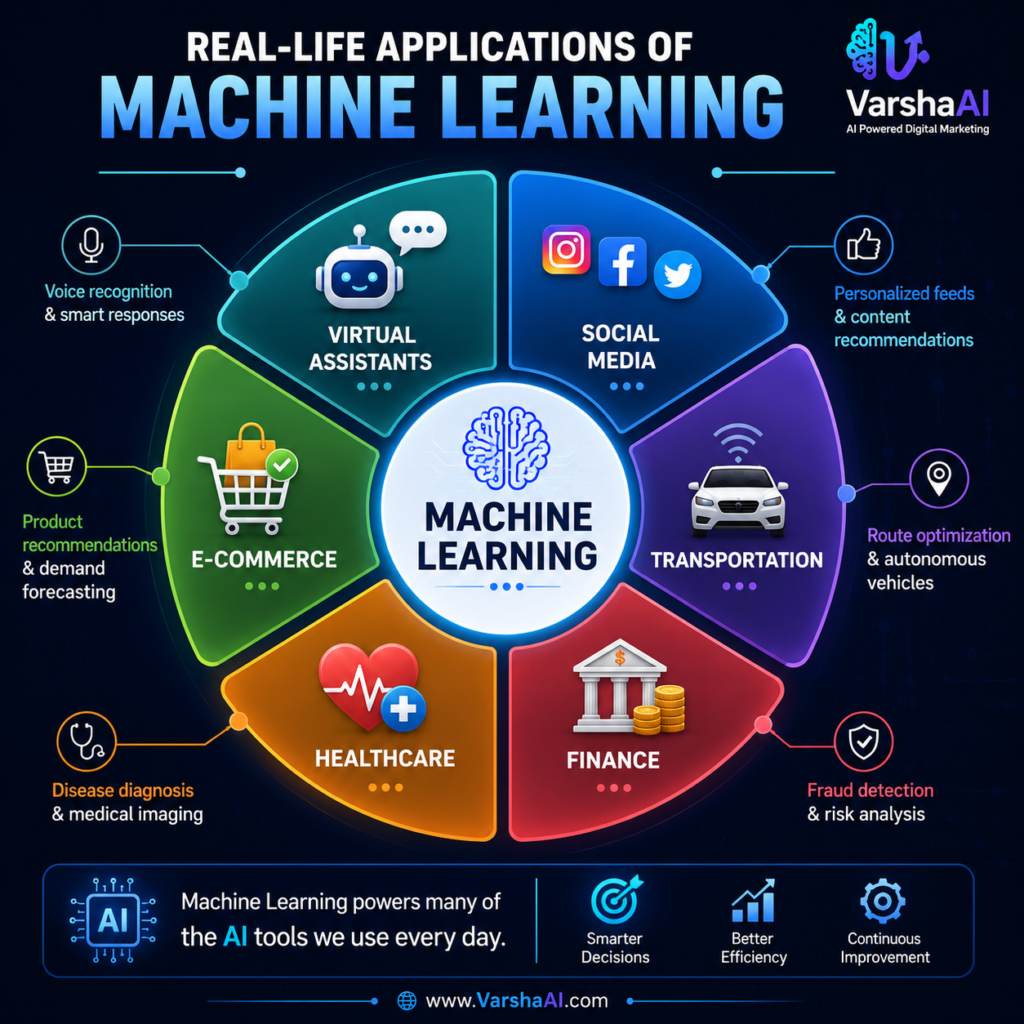
Machine learning has moved well beyond tech companies — it’s now core infrastructure across most major industries:
- Healthcare — Predicting disease risk, analyzing medical scans, and speeding up drug discovery.
- Finance — Fraud detection, credit scoring, and algorithmic trading.
- Retail & E-commerce — Personalized product recommendations and demand forecasting.
- Transportation — Route optimization and the perception systems behind self-driving vehicles.
- Marketing — Ad targeting, customer segmentation, and predicting which content will perform well (closely tied to how AI is used for SEO).
- Manufacturing — Predictive maintenance, catching equipment failures before they happen.
- Agriculture — Crop yield prediction and monitoring plant health via satellite imagery.
Advantages and Disadvantages of Machine Learning
Advantages
- Automates complex tasks that would be impossible to hand-code with fixed rules.
- Improves over time as it’s exposed to more and better data.
- Uncovers patterns in data that humans might miss entirely.
- Scales easily — once trained, a model can process massive amounts of data quickly.
Disadvantages
- Requires large amounts of quality training data to perform well.
- Can inherit and amplify biases present in the training data.
- Model decisions can be difficult to explain (“black box” problem), especially with deep learning.
- Requires ongoing monitoring, since performance can degrade if real-world data shifts over time.
Weighing these trade-offs is part of why “data quality” and “model accuracy” come up so often in any serious discussion about deploying machine learning responsibly.
Career Opportunities in Machine Learning
If this topic interests you beyond just using AI tools, machine learning has become one of the fastest-growing career fields in tech. Common roles include:
- Machine Learning Engineer — Builds and deploys ML models into real products.
- Data Scientist — Analyzes data, builds models, and extracts business insights (a role that blends statistics, data science, and ML).
- Data Analyst — Works with data and predictive analytics, often as a starting point before moving into ML-focused roles.
- AI/ML Researcher — Develops new algorithms and techniques, typically in academic or R&D settings.
- NLP Engineer / Computer Vision Engineer — Specializes in language-based or image-based ML applications specifically.
Even outside dedicated ML roles, understanding machine learning is increasingly valuable in marketing, product, and content careers — since so many of the tools in those fields are now built on top of it.
How Beginners Can Start Learning Machine Learning
You don’t need a computer science degree to start learning the basics. Here’s a realistic beginner path:
- Start conceptual, not technical. Understand ideas like training data, models, and predictions before touching any code — this guide is a good first step.
- Learn basic Python. Python is the most widely used language in ML, thanks to beginner-friendly libraries.
- Take a structured beginner course. Free options like Google’s Machine Learning Crash Course or Kaggle’s micro-courses are solid starting points.
- Practice with real datasets. Sites like Kaggle offer free datasets and beginner competitions to practice on.
- Build one small project. Something simple, like predicting house prices or classifying images, cements the concepts far better than reading alone.
- Learn key algorithms one at a time. Start with linear regression and decision trees before moving to neural networks.
Most beginners can grasp the fundamentals within a few weeks of consistent study — building real technical skill naturally takes longer, but that’s true of any technical field.
Machine Learning vs. AI vs. Deep Learning: What’s the Difference?
These three terms get used interchangeably, but they aren’t the same thing:
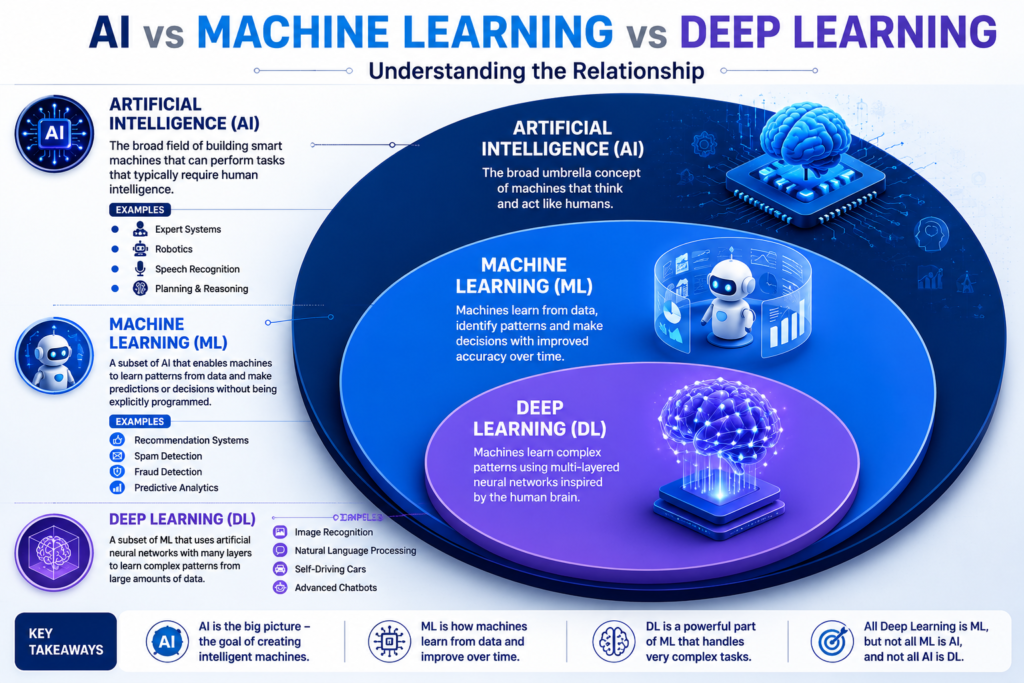
- Artificial Intelligence (AI) is the broadest term — any system designed to perform tasks that typically require human intelligence.
- Machine Learning (ML) is a subset of AI — specifically, systems that learn from data rather than following fixed rules.
- Deep Learning is a subset of ML — it uses layered structures called artificial neural networks, loosely inspired by the human brain, and is behind many of today’s most advanced AI tools, including large language models, computer vision systems, and NLP applications.
Think of it as three circles inside each other: AI is the biggest circle, ML sits inside it, and deep learning sits inside ML.
Common Machine Learning Myths (Beginners, Take Note)
- “Machine learning is basically magic.” It isn’t — it’s statistics and pattern recognition at scale. Understanding the basic flow (data → model → prediction) demystifies most of it.
- “You need to know advanced math to use ML tools.” Not true for using ML-powered products (like AI writing tools or recommendation engines). You only need deep math knowledge if you’re building models yourself.
- “Machine learning is always accurate.” Models are only as good as the data they’re trained on. Biased or incomplete data leads to biased or incorrect predictions.
- “AI and machine learning are the same thing.” As covered above, ML is just one part of the broader AI field.
- “You need a powerful computer to learn ML.” Most beginner learning happens through free, cloud-based tools like Google Colab — no expensive hardware required.
Why Should Beginners in Marketing or Blogging Care About This?
If you’re learning digital marketing, SEO, or blogging — like most readers here — machine learning already affects your work directly:
- Google’s search ranking systems rely heavily on machine learning to understand content quality and search intent.
- AI tools you might already use for content creation or ChatGPT for digital marketing are built on machine learning models.
- Ad platforms use ML to decide who sees your ads and when, based on predicted behavior.
Understanding the basics of machine learning helps you use these tools more intentionally, instead of treating them as an unpredictable black box.
FAQs
What is machine learning in simple words? Machine learning is a way for computers to learn from data and improve at a task over time, without being explicitly programmed with rules for every situation.
Is machine learning the same as AI? No. AI is the broader field of making machines act intelligently. Machine learning is one specific approach to achieving that, based on learning from data.
Can machine learning work without AI? Not really — machine learning is considered a subfield of AI, so in practice, any working ML system is already a form of AI, just not the only form AI can take.
Does ChatGPT use machine learning? Yes. ChatGPT is built on a large language model, which is a deep learning system — and deep learning is itself a specialized branch of machine learning.
Is Python required for machine learning? Not to understand ML conceptually, but yes, if you want to build your own models. Python is the most common language used because of its beginner-friendly ML libraries.
Which companies use machine learning? Nearly all major tech companies use it, including Google, Netflix, Amazon, and Meta, along with a growing number of banks, hospitals, retailers, and manufacturers.
How long does it take to learn machine learning basics? Most beginners can understand the core concepts within a few weeks of consistent study. Becoming job-ready as an ML practitioner typically takes several months to a couple of years, depending on your starting point.
Do I need to code to understand machine learning? No. You can understand machine learning conceptually and use ML-powered tools without ever writing code. Coding is only needed if you want to build your own models.
What are some real-life examples of machine learning? Spam filters, streaming recommendations, voice assistants, fraud detection, and search engine ranking are all everyday examples of machine learning in action.
What’s the difference between machine learning and deep learning? Deep learning is a specialized subset of machine learning that uses neural networks with multiple layers, and it powers many of today’s most advanced AI systems.
What is training data in machine learning? Training data is the set of labeled or unlabeled examples used to teach a machine learning model to recognize patterns before it’s tested on new, unseen data.
What’s the difference between classification and regression? Classification predicts a category (like “spam” or “not spam”), while regression predicts a continuous number (like a price or temperature).
Is machine learning hard to learn? The basic concepts are beginner-friendly and can be understood without a technical background. Building your own ML models does require more advanced math and coding skills.
What is feature engineering? Feature engineering is the process of selecting or creating the specific data inputs that help a machine learning model make more accurate predictions.
Conclusion
Machine learning isn’t a mysterious, futuristic concept — it’s a practical way for computers to learn from data instead of following rigid rules, and it already quietly powers much of the technology you use every day. Once you understand the basic idea — data in, patterns learned, predictions out — the rest of the AI world becomes a lot easier to make sense of.
Your Next Step
Now that you understand what machine learning is, the natural next step is seeing how it’s already showing up in tools you may already use. Explore our guide on AI Tools for Digital Marketing to see machine learning in action.